
About this map
Why we built it
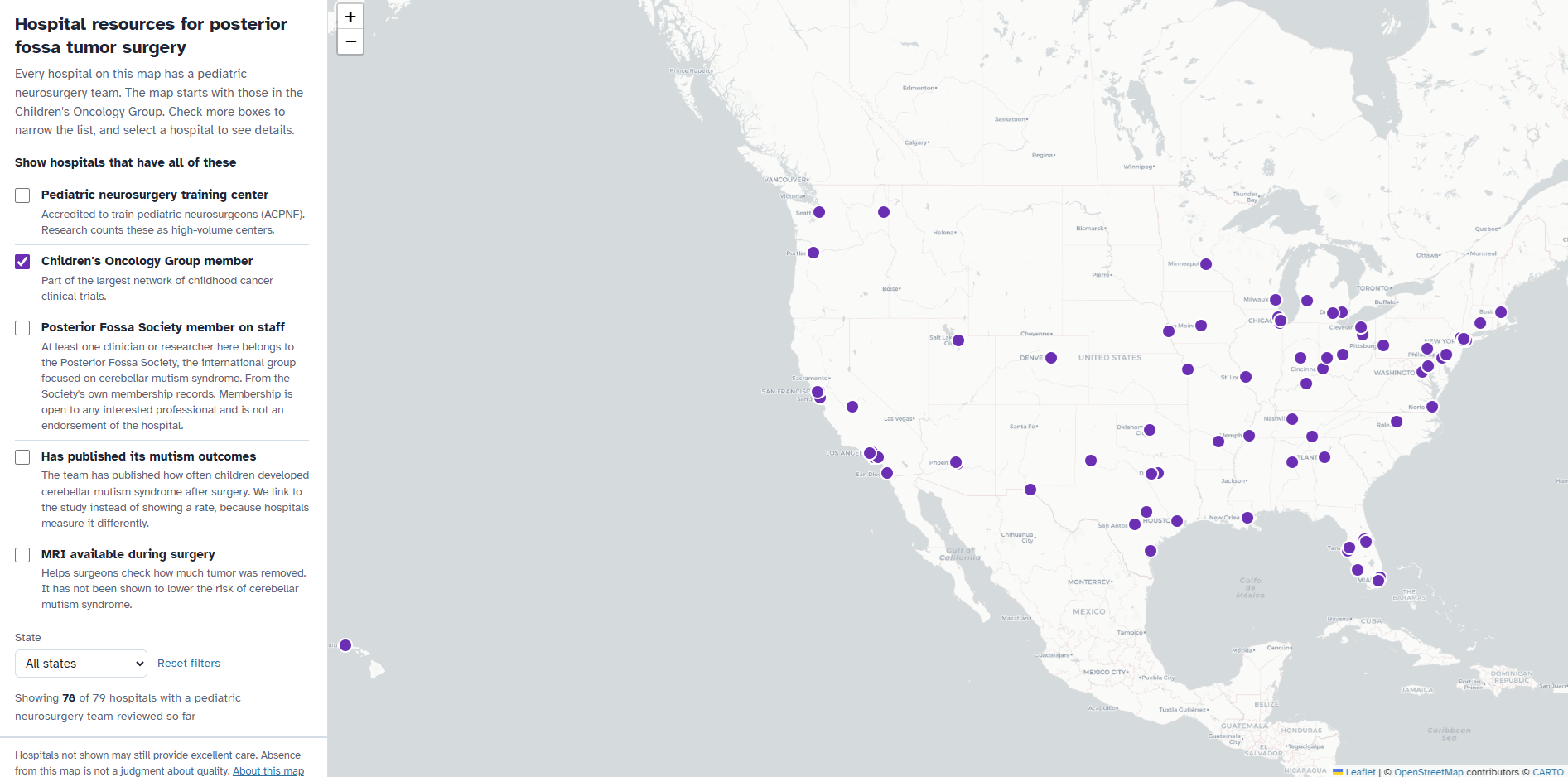
When a child is diagnosed with a posterior fossa tumor, families often have to choose a hospital quickly. The Posterior Fossa Society built this map to help families find hospitals with resources that matter for this surgery. It is guided by our Neurosurgery Special Interest Group’s consensus statement (Toescu et al., Journal of Neurosurgery, 2025) on best practices to reduce pediatric postoperative cerebellar mutism syndrome (ppCMS), which is more commonly called posterior fossa syndrome (PFS).
This map is not a ranking, and it does not recommend any hospital. It shows which hospitals have certain resources, based on public sources we could verify. Many excellent hospitals may lack one or more of these features, and a feature on its own does not guarantee a good outcome. Please talk with your child's care team about which hospital is right for your family.
Which hospitals are included
A hospital appears on the map only if we found public evidence that it has a pediatric neurosurgery team that operates on brain tumors at that location. Acceptable evidence included the hospital's own neurosurgery or brain tumor pages, surgeon profiles, hospital announcements, and news coverage of the hospital's program.
We started from four lists:
the hospitals of pediatric neurosurgery fellowship programs accredited by the Accreditation Council for Pediatric Neurosurgical Fellowships (ACPNF), as listed in January 2026;
hospitals that sponsor the pediatric neurosurgery traveling fellowships of the AANS/CNS Section on Pediatric Neurological Surgery;
the U.S. institutions with membership in the Posterior Fossa Society; and
the children's hospitals on the Children's Oncology Group (COG) member list.
Information for each hospital was checked individually. Public sources were searched with the help of an AI research assistant, and each finding was recorded with its source for manual review. Some hospitals on these lists are not shown because we could not document a pediatric neurosurgery team that operates on brain tumors. That does not mean the hospital lacks one, only that we could not confirm it from public sources. Outpatient clinics, foundations, and research centers on the COG list are not shown because they do not perform surgery.
The map is never final nor complete. Many COG members are listed under a university or cancer center name. For these, we must first identify which hospital performs the surgery before we can check it. We will add hospitals as we verify them.
What each filter means
Children's Oncology Group member (shown by default). The hospital, or the cancer program it partners with on the same campus, appears on the U.S. member list of the Children's Oncology Group. COG is the largest pediatric cancer research network in North America, and membership gives families access to its clinical trials. Where a hospital's cancer care is provided through a partner institution, we credit the hospital where the surgery takes place.
Posterior Fossa Society member on staff. At least one current member of the Society works at the hospital. We matched members to hospitals using institutional email addresses from the Society's membership list, and we show no names. Membership reflects professional interest in posterior fossa syndrome. It is not an endorsement by the Society.
MRI available during surgery. A public source states that the hospital has an intraoperative MRI, a scanner that lets surgeons take MRI images during the operation. This enables surgeons to check for remaining tumor after debulking, which may improve the visibility of tumor boundaries and their proximity to sensitive brain tissues. Its direct effect on the risk of posterior fossa syndrome has not been established. Published hospital series report that this is safe in children and reduces the need for a second operation, at the cost of a longer surgery (for example, Choudhri et al., American Journal of Neuroradiology, 2014). "Not marked" means we did not find public evidence, not that the hospital lacks the technology.
Has published research on posterior fossa syndrome in its patients. The hospital's own team has published, in a peer-reviewed journal in 2016 or later, research related to posterior fossa syndrome. This shows that the hospital recognizes the syndrome, and that it tracks core symptoms with enough fidelity to conduct research. We find these studies with a standardized PubMed search for every hospital, recorded so it can be repeated at each update.
Pediatric neurosurgery training center. The hospital hosts, or is part of, a pediatric neurosurgery fellowship program accredited by ACPNF, as listed in January 2026. These programs train future pediatric neurosurgeons and must meet standards for surgical experience and faculty. We use accreditation as a marker of an established pediatric neurosurgery service. Where one program spans more than one hospital, each participating hospital is marked.
Has published institutional rates of posterior fossa syndrome. The hospital's own team has published, in a peer-reviewed journal in 2016 or later, how often the syndrome occurred in a defined group of children who had surgery at that hospital, according to a contemporary standard definition (Gudrunardottir et al., Child’s Nervous System, 2016). Publishing these results shows that a hospital tracks this outcome closely and transparently with conventional methodology. Rates still vary depending on who evaluates each patient and which tumor types a hospital treats, so they are hard to directly compare between hospitals.
Information we did not use
We did not use commercial rankings such as U.S. News & World Report. Their pediatric cancer rankings do not measure posterior fossa tumor surgery specifically, and their badges are licensed products. We did not use surgical volume figures unless a hospital reported them to us directly.
Hospital review and corrections
We plan to send each listed hospital a short survey so it can confirm or correct its information and supply details that public sources do not provide. Until a hospital responds, the map shows only information we verified from public sources. A hospital may ask to be removed from the map at any time.
If you believe any information is wrong or out of date, please contact us at info@posteriorfossasociety.org. We record every correction request and its outcome.
Map locations are approximate. Always confirm a hospital's address and services directly with the hospital.
How often we update
We plan to review the map at least once per year, and we check the ACPNF and COG lists at each review. Each hospital's details show the date we last verified them. Information current as of September 2026.
Conflicts of interest
Members of the Posterior Fossa Society, including those who prepared this map, work at some of the hospitals shown. Hospitals were included by the rules above, applied the same way to every hospital. No hospital paid to be included or was consulted about its listing prior to publication.